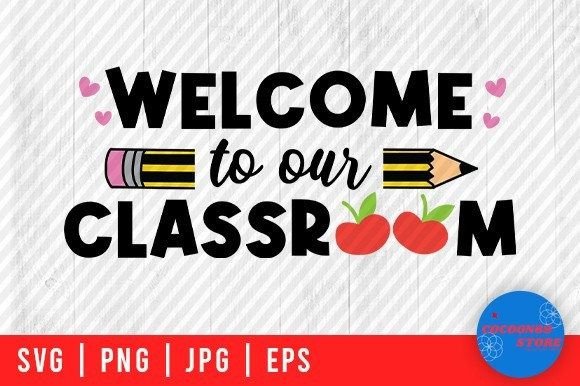
Welcome to Our Classroom SVG: An Embroidery Review
First Impressions: Evaluating the Design for Stitching
When I first opened the files for the Welcome to Our Classroom, School Svg, my immediate focus was not just on the visual appeal but on its structural integrity as a potential machine embroidery design. As a designer who frequently bridges the gap between digital graphics and tangible textiles, I look for clean vector paths that translate well into stitch data. This particular graphic carries a warm, inviting mood that is essential for educational environments. The layout suggests a balanced composition, which is critical when converting 2D art into a 3D stitched reality. For those of us in the Crafts category, specifically working with Graphics intended for multi-media use, this design offers a versatile foundation. However, before loading it into digitizing software, I had to assess whether the line weights and negative spaces would survive the transition from screen to fabric.
The instant download includes SVG, PNG, EPS, and JPG files in high resolution. While these are primarily marketed for printing on items like mugs or stickers, an experienced embroiderer knows that high-resolution vectors (SVG/EPS) are the gold standard for creating custom embroidery files. The clarity of the lines in this Welcome to Our Classroom, School Svg indicates that it should digitize cleanly, minimizing the jagged edges that often plague low-quality raster conversions. My initial assessment is that this artwork has the personality required for a standout handmade product, provided the technical execution matches the artistic intent.
Real-World Application: Stitching a Teacher Appreciation Tote
To truly evaluate this design, I approached it with a specific project in mind: a custom canvas tote bag design for a teacher appreciation gift. Teachers receive countless generic items, so my goal was to create a personalized gift that felt professional yet heartfelt. I envisioned the "Welcome to Our Classroom" text centered on a natural cotton canvas tote, perhaps surrounded by subtle botanical elements derived from the graphic's aesthetic.
In this real-life scenario, the design needed to perform under the constraints of heavy-duty fabric. Canvas is unforgiving; it requires precise tension and adequate stabilization. I considered how the lettering in the Welcome to Our Classroom, School Svg would interact with the weave of the canvas. If the font is too thin, it risks getting lost in the texture. If it is too dense, it could cause puckering or needle breaks. For this tote, I determined that a combination of satin stitch for the main title and a lighter fill stitch or running stitch for background accents would provide the best contrast without compromising the bag's utility. This practical test highlights why we must view digital assets through the lens of physical application. A beautiful screen image does not always guarantee a successful finished product.
Navigating Fabric Challenges and Technical Constraints
While the Welcome to Our Classroom, School Svg is versatile, there are specific scenarios where caution is necessary. As an Etsy seller or small shop owner, you cannot apply the same digitizing parameters to every substrate. Here are critical considerations based on my review:
- Stretchy Fabrics: If applying this to a sweatshirt embroidery project or baby onesie, the design’s stability is paramount. Knits move. You must use appropriate cut-away stabilizer and potentially a topping to prevent stitches from sinking into the pile. Complex details in the SVG may need to be simplified to accommodate the stretch.
- Small Hoop Sizes: Not everyone has a large commercial hoop. If you are working with a 4x4 hoop, verify that the aspect ratio of the Welcome to Our Classroom, School Svg fits without excessive resizing. Drastic reduction can turn readable text into illegible thread blobs. Always check the minimum legible size for your specific machine and thread weight.
- Dark vs. Light Fabrics: High contrast is key. On dark fabrics, ensure the digitized version includes adequate underlay to prevent the fabric color from bleeding through light threads. Conversely, on white linens for holiday embroidery or tea towels, avoid overly dense backing that creates a stiff, bulletproof patch effect.
- Curved Surfaces: Caps and curved sleeves present unique geometry. Flat artwork must sometimes be distorted or arced during digitizing to appear straight once stitched on a curve. Test the design on a curved surface before committing to a bulk order of custom apparel.
Impact on Product Value and Brand Professionalism
For creative entrepreneurs and craft business owners, the quality of your embroidery directly influences customer trust. Using a well-structured source file like the Welcome to Our Classroom, School Svg elevates the perceived value of your merchandise. When a client sees crisp lettering and intentional spacing rather than messy jump stitches or uneven density, they recognize the professionalism behind the handmade product.
This design also serves as an excellent asset for branding consistency. Whether you are creating commercial embroidery for a school district or selling individual digital embroidery files to other makers, maintaining a cohesive visual language is vital. The welcoming, educational theme of this graphic resonates deeply with parents and educators, making it a high-converting niche for Etsy sellers. Furthermore, because the listing includes high-resolution PNG and JPG files, you can easily create accurate printable mockups for your listings before stitching a single sample. This allows you to market design assets efficiently while ensuring the final embroidered result aligns with customer expectations.
Essential Designer Notes for Safe Execution
Before you begin production or list items featuring the Welcome to Our Classroom, School Svg, adhere to these professional best practices to protect your reputation and equipment:
- Verify Licensing: The product description states it can be printed on various items, but it does not explicitly detail embroidery-specific commercial licensing terms. Always confirm whether you have the rights to sell finished embroidered goods or digitized versions of this file. Respecting intellectual property is non-negotiable for sustainable business.
- Test on Scrap Fabric: Never run a new design directly on a client’s garment. Use scrap material of similar weight and texture to check stitch density, registration, and overall feel. This step saves money and prevents heartbreak.
- Check Thread Color Contrast: Digital colors do not always match rayon or polyester thread charts. Physically compare your thread selection against the fabric to ensure readability. What looks vibrant on a backlit monitor might appear muddy on matte cotton.
- Inspect Small Details: Zoom in on the digitized version. Are the serifs on the letters distinct? Is the spacing between words sufficient to prevent thread buildup? Tiny details that look elegant in vector format may require modification to function as a durable embroidered patch or garment decoration.
- Stabilizer Selection: Match your stabilizer to the end use. A tear-away might suffice for a woven sign, but a wash-away or cut-away is mandatory for baby embroidery or garments that will face frequent laundering. The longevity of the Welcome to Our Classroom, School Svg design depends entirely on proper foundational support.
Ultimately, the Welcome to Our Classroom, School Svg represents a strong starting point for makers who understand the translation process from pixel to stitch. By approaching this graphic with technical mindfulness and respect for the medium, you can transform a simple digital download into a cherished, professional-grade textile product that truly welcomes students and celebrates educators.